Skip to content
Tanumay GoswamiGet in touch

Tanumay GoswamiI move enterprise automation to the cloud
and keep it running.

Automation engineer · PepsiCo GBS India LLP · Process Analytics and Automation Associate Analyst · Aug 2023 — Present

Migration, delivery pipeline, sustain — the part of automation that starts after go-live. Three years of it at PepsiCo: a full-sector move to Cloud Orchestrator, the CI/CD pipeline six global teams deploy through, and production support for everything already running.

200+
Automations migrated
0
Business disruptions
450+
Automations deployed via CI/CD
$250K
Saved annually

Profile

About

Most automation work is measured at the demo. Mine is measured a year later — after the framework changed, the servers moved, the team doubled, and the process owner left. That is the part I am good at: taking an estate somebody else built, moving it somewhere better, and having nothing break while it happens.

The pattern repeats across everything below. Find what is actually running, understand why it was built that way, sequence the change so operations never feel it, then leave behind a pipeline and a document so the next person does not have to rediscover any of it.

How I work

Migrate in an order the business agrees to
Sequence by business criticality, not by what is easiest to move first, and keep the old path warm until the new one has proved itself in production.
A deployment nobody can trace is a deployment nobody can fix
Code belongs in version control and reaches production through a pipeline. Every release should have an author, a commit and a way back.
Watch it before it breaks
Queues, logs and exception rates on a dashboard beat a business user telling you their report never arrived. Degradation is visible long before an outage is.
Write it down once so it is not investigated twice
A documented root cause and a handover a stranger can follow are worth more than the fix itself, because they are what stops the next person repeating the work.

Case studies

Work

Six pieces of work from one role. The problem each started from, the approach taken, and what it was worth to the business.

RND-SAMPLESIntake and cross-border movement, built end to end

R&D Samples Management System

The problem

An R&D sample that has to cross a border is not one process, it is four: someone requests it, someone approves it, someone prepares the import and export paperwork, and someone tracks where it actually is. Run over email and spreadsheets, every handoff adds a wait, and the requester ends up chasing status rather than working.

What I did

Built one intake on Power Apps so every request enters the same way, orchestrated the approvals and routing in Power Automate, and used UiPath for the repetitive system entry and document handling underneath. The import and export steps were modelled as part of the same workflow rather than as a manual process bolted on at the end.

R&D samples — one workflow from request to cross-border dispatchA sample request is submitted through a Power Apps intake, routed for approval by Power Automate, carried through import and export documentation, and then dispatched and tracked. UiPath performs the repetitive system entry and document handling beneath every stage. Processing time fell 70 percent, manual communication 50 percent, and request turnaround 40 percent.R&D SAMPLE REQUEST70% faster processingRequestPower Apps intakeApprovalPower AutomateImport / exportdocumentationDispatchand trackingUiPath · system entry and document handling beneath every stage
R&D samples — one workflow from request to cross-border dispatch
70%
cut in processing time
50%
less manual communication
40%
faster request turnaround

Business value

Requests move on their own instead of being chased, and the requester gets a status they can read rather than an email thread they have to reconstruct.

  • Power Apps
  • Power Automate
  • UiPath
  • SharePoint
FSO-650Award-winning automation for PFNA

Employee Onboarding FSO Scheduler

The problem

Every new hire triggers a series of milestone events that have to land on the right working day. At 650+ events a month this is both a volume problem and a correctness problem: weekends and public holidays shift dates, and a missed milestone is not an abstraction — it is felt by a person in their first week.

What I did

Automated the full scheduling chain across UiPath, Power Platform, SharePoint and Outlook, with weekend and holiday handling built into the date calculation rather than corrected afterwards. Added real-time exception status so anything that failed to schedule was visible immediately instead of being discovered by the new hire.

Onboarding scheduler — milestones placed on the correct working dayA new hire record triggers milestone calculation. Each date is adjusted for weekends and public holidays before events are created in Outlook and SharePoint. Anything that fails to schedule is surfaced as a real-time exception rather than being discovered by the new hire. Over 650 milestone events are scheduled every month, cutting manual scheduling effort by 70 percent.ONBOARDING MILESTONES650+ events every monthNew hirerecord createdMilestonescalculatedBusiness dayweekend + holidayEvents createdOutlook · SharePointException statussurfaced in real time, not discovered on day one
Onboarding scheduler — milestones placed on the correct working day
650+
milestone events automated monthly
70%
less manual scheduling effort
PFNA CIO
2H 2023 Award, Be Consumer Centric

Business value

New hires get their milestones on the correct working day without a coordinator maintaining a calendar by hand, and exceptions surface to someone who can fix them while there is still time.

  • UiPath
  • Power Platform
  • SharePoint
  • Outlook integrations
DASH-27Procurement Intelligence Dashboard

Macro & Commodity Dashboard

The problem

Procurement decisions depend on macro and commodity data spread across public and paid providers, each with its own format, refresh cadence and access method. Assembled by hand, the numbers are already stale by the time the deck is built, and nobody can say with confidence which figures were refreshed this cycle and which were carried over from the last one.

What I did

Orchestrated 27+ recurring reports from 10+ public and paid sources into a single Procurement Intelligence Dashboard, automating retrieval and consolidation so the dashboard refreshes on a schedule instead of being rebuilt each cycle by whoever owns the deck.

Procurement intelligence — many sources, one scheduled refreshMore than ten public, paid and internal sources feed a scheduled orchestration that assembles over 27 recurring reports and publishes them into a single Procurement Intelligence Dashboard. The dashboard refreshes on a schedule instead of being rebuilt by hand each cycle, an 80 percent gain in reporting efficiency.MACRO & COMMODITY DATA80% gain in reporting efficiencyPublic data feedsPaid providersInternal systemsScheduled exports10+ public and paid sources in totalOrchestration27+ recurring reportsProcurement Intelligenceone dashboard, refreshed on schedule
Procurement intelligence — many sources, one scheduled refresh
27+
recurring reports orchestrated
10+
public and paid sources
80%
gain in reporting efficiency

Business value

Procurement reads current numbers from one place, and the manual data handling that used to produce them is gone rather than redistributed.

  • UiPath
  • Python
  • SQL
  • Power Platform
MIG-200Owned end to end for a full PepsiCo sector

Sector cloud migration

The problem

A full sector was running 200+ production automations on a legacy UiPath framework, tied to on-premise Orchestrator and an ageing Windows runtime. The framework was going out of support and the runtime had to move, but the automations underneath it were load-bearing — processes business teams depended on daily. A migration that paused operations was not an option, and a big-bang cutover across 200+ solutions was not survivable.

What I did

Inventoried the estate first, then rebuilt each automation against the Windows-compatible framework and repointed it at Cloud Orchestrator. Work was sequenced by business criticality rather than by ease, so the processes with the least tolerance for downtime moved on a schedule their owners agreed to, with the legacy path kept warm until the replacement had proved itself in production.

Migration path — legacy on-premise framework to Cloud OrchestratorBefore: UiPath Studio on the legacy RE Framework publishes to an on-premise Orchestrator, which runs automations on Windows Server bot runners. After: Studio on the Windows-compatible framework publishes to UiPath Cloud Orchestrator, which runs them on cloud-managed runners. The cutover was sequenced by business criticality, and 200 or more automations moved with zero business disruption.BEFORE200+ automations · legacy framework, out of supportUiPath Studiolegacy RE FrameworkOn-prem Orchestratorself-hostedWindows Server runnersageing runtimesequenced by business criticalityAFTER0 business disruptionsUiPath StudioWindows-compatible frameworkCloud OrchestratorUiPath-managedCloud-managed runnerssupported runtime
Migration path — legacy on-premise framework to Cloud Orchestrator
200+
automations migrated
0
business disruptions
1
full sector, owned end to end

Business value

The sector cleared its unsupported-framework risk and moved onto cloud infrastructure without a single business interruption — and without the parallel-running costs a staged fallback usually incurs.

  • UiPath Studio
  • RE Framework
  • Cloud Orchestrator
  • Windows Migration
CICD-450Platform work adopted by 6 global teams

Automation delivery pipeline

The problem

Automation code lived inside Orchestrator and reached production by being published from a developer machine. There was no version history, no review step, and no reliable way to tell which build was live. With six teams shipping across regions, two developers could overwrite each other and only find out when a process failed in production. Each deployment took around thirty minutes of manual work.

What I did

Moved the automation codebases out of Orchestrator and into Git, then built CI/CD pipelines in Azure DevOps to package and promote them through environments. Publishing became a pipeline run against a reviewed commit instead of a manual action, which gave every deployment a version, an author and a rollback point.

Delivery pipeline — from a developer machine to a reviewed, versioned releaseAutomations are authored in UiPath Studio, committed to Git for version history and review, built and packaged by an Azure DevOps pipeline, promoted through Orchestrator development, test and production environments, and consumed by six global teams. Over 450 automations have shipped through this path, and deployment time per automation fell from about thirty minutes to five. It replaced publishing directly from a developer machine to Orchestrator, which had no version history, no review step and no rollback point.AUTOMATION DELIVERY PIPELINE450+ automations · 30 min → 5UiPath StudioauthorGitversion + reviewAzure DevOpsbuild · packageOrchestratordev → test → prod6 global teams450+ automationsREPLACEDpublish direct from a developer machine — no version history, no review, no rollback point
Delivery pipeline — from a developer machine to a reviewed, versioned release
450+
automations deployed through the pipeline
30 → 5
minutes to deploy an automation
6
global teams on one delivery path

Business value

Releases became repeatable and auditable across six regions, and six times faster to run. A failed deployment can be traced to a commit and rolled back, instead of being diagnosed from scratch against a live process.

  • Azure DevOps
  • Git
  • CI/CD
  • Orchestrator
  • UiPath Studio
INFRA-130Cost review across the automation estate

Infrastructure and licence optimisation

The problem

Bot licences accumulate faster than they are retired. Every decommissioned process, every pilot that did not proceed, and every over-provisioned environment leaves a licence attached to it — and licences renew whether or not anything is running on them.

What I did

Audited actual utilisation across the estate against what was provisioned, separated genuinely idle capacity from seasonal and low-frequency workloads, and decommissioned what was confirmed unused. The point was to cut cost without cutting headroom the business would need back.

130+
bot licences decommissioned
$250K
saved annually

Business value

$250,000 a year returned to the business as recurring savings, from infrastructure that was being paid for and not used.

  • UiPath Insights
  • Orchestrator
  • Capacity analysis
GCC-806 sector teams onboarded as the group scaled into a GCC

Build-to-sustain transition

The problem

A regional RPA team was scaling into a Global Capability Centre serving six sectors. Processes built by regional teams had to become processes a central team could support — which is a documentation and handover problem long before it is a technical one. Undocumented automation transferred between teams becomes unsupportable automation.

What I did

Transitioned processes from development into sustain with complete documentation and support readiness for each, so the receiving team inherited a runnable, diagnosable product rather than a codebase. Onboarded six sector teams onto the shared way of working.

80+
processes moved from build to sustain
6
sector teams onboarded

Business value

Six sectors ended up supported from one capability centre, with each transferred process documented well enough to be run by people who had never built it.

  • Process transition
  • Documentation
  • Support readiness
  • Orchestrator
SUSTAINStanding ownership of live automation products

Sustain operations and governance

The problem

Automation in production fails quietly. A queue backs up, an exception rate creeps, a scheduled job silently stops firing — and the first anyone hears of it is a business user asking where their report is. Reactive support means every incident is discovered late and diagnosed from nothing.

What I did

Ran monitoring on UiPath Insights dashboards tracking logs, queues and exceptions in real time, so degradation was visible before it became an outage, and owned incident resolution and break-fix through to closure. Standardised the aftermath as well as the response: authored four Knowledge Base articles on PepsiCo ServiceNow and created the RCA template the team now uses org-wide.

4
Knowledge Base articles published
Org-wide
RCA template adoption

Business value

Incidents were caught from dashboards rather than from complaints, and each one produced a reusable artefact — so the same root cause did not need investigating twice by two different people.

  • UiPath Insights
  • ServiceNow
  • Incident Management
  • RCA
  • Production Support

Personal project · solo

Credit Card Spend Intelligence

An automated pipeline that turns password-protected credit card statement PDFs from three Indian banks into a self-updating Power BI dashboard, with daily alert emails and no manual steps.

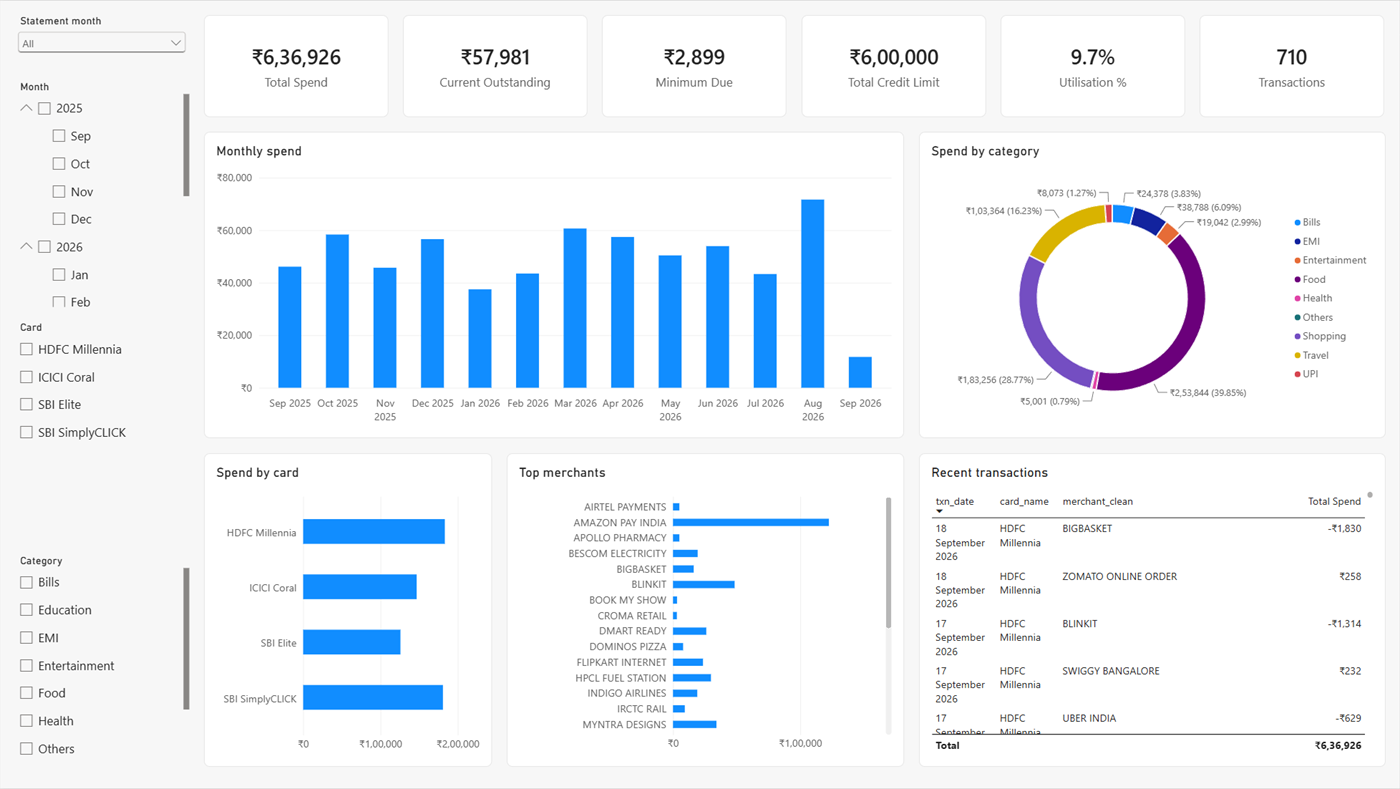
Power BI overview page showing total spend, outstanding balance, minimum due, credit limit, utilisation and transaction count, with monthly spend, spend by category, spend by card, top merchants and recent transactions.

The problem

Seven credit cards across HDFC, ICICI and SBI, and every statement arrives as an encrypted PDF in a different layout. Power BI cannot open a password-protected PDF at all, and no app shows all seven cards in one place — so spending, dues, EMIs and credit utilisation sat scattered across dozens of PDFs in an inbox, each bank in its own format.

What it does

A daily job pulls statements from Gmail over IMAP, routes each PDF to the right card, skips anything it already has, and decrypts it. A parser per bank reads the layout, and every statement is reconciled to the paisa against the bank’s own printed totals. A spend engine then resolves what the numbers actually mean: a refund is matched to the purchase it cancels, an EMI conversion nets to zero, and a bounced autopay is not counted as spend. The results feed a five-page Power BI dashboard, and the same job refreshes it, backs up the data, and emails a summary of dues, spending and anything that needs attention.

7
cards across 3 banks
64
statements, every one reconciled to the printed totals
1,150+
transactions parsed
100%
of spend categorised, up from 52%
390
automated tests, with ruff and mypy
~5,200
lines of Python
Statement pipeline — encrypted PDF in, refreshed dashboard outStatements are fetched from Gmail over IMAP, deduplicated and routed to the right card, then decrypted and read by a parser per bank for HDFC, ICICI and SBI. Every statement is reconciled against the bank's printed totals before a spend engine categorises it, and the results feed a five-page Power BI dashboard. A Windows scheduled job runs the whole chain daily, refreshes Power BI Desktop through UI Automation, sends an alert email, and writes incremental backups. Passwords live in Windows Credential Manager.PIPELINE64 of 64 statements reconciledGmailIMAP fetch, dedupeDecrypt + parseHDFC · ICICI · SBIReconcilevs printed totalsCategorisespend enginePower BI5 pages, 21 measuresRUNS ITSELFTask Schedulerdaily, unattendedRefreshvia UI AutomationAlert emaileach item told onceBackupsOneDrive + disk
Statement pipeline — encrypted PDF in, refreshed dashboard out

What was actually hard

Reconciliation as the test oracle
PDF text extraction fails silently: a dropped line simply disappears, and nothing errors. So every statement’s parsed debits are checked against the bank’s own printed totals. That caught a header wrapped over two lines, EMI columns read in the wrong order, and noise introduced when the test fixtures were redacted.
Refreshing Power BI Desktop the supported way
Microsoft does not support sending refresh commands to a model open in Desktop. So the job presses Desktop’s own Refresh button through Windows UI Automation, then confirms it worked with a read-only query on the model’s refresh time.
Spend that matches the bill
Refunds are matched to the purchases they cancel — same card, exact amount, within 90 days, nearest first. EMI conversions net out and bounced autopays are excluded. The result is a dashboard total that matches what the banks actually billed.
Calendar month versus statement month
A statement runs across two calendar months, so an ordinary date table splits one bill’s purchases in two. Each transaction now carries the date of the statement that billed it, and a second month table is keyed from both the statements and the transactions — so one filter shows a month’s bills together with exactly the purchases on them.

How it is built

Categorisation
A merchant map first, then keyword rules in priority order, then a UPI fallback. A merchant it has not seen goes to a review queue.
Dashboard
Five pages and 21 DAX measures, in the Indian number format (lakhs). Credit limits pooled across cards, EMI principal against interest derived with annuity and present-value maths, and four filters shared by every page.
Engineering
390 automated tests with ruff and mypy, locked dependency versions, GitHub Actions CI running on Windows, and a design document and implementation plan for each feature.
Scope
Solo: design, parsing, data model, DAX, automation, testing and CI.

What lands in the inbox

illustrative numbers

Subject

Credit cards: 1 new statement, 1 needs attention

New statements
- SBI Elite: September statement imported (15 Aug to 14 Sep).
  Total due ₹18,420, minimum ₹920, due 4 Oct 2026 (in 8 days).
  Spent ₹17,960 in 42 transactions: Quick Commerce ₹4,210 (23%), EMI ₹3,500 (19%),
  Restaurants ₹2,980 (17%).

Power BI was open and has been refreshed.

Needs attention
- HDFC Millennia: no October statement yet (expected around 18 Oct).
  Look for it in Gmail. If this card is billed only in months you use it, set
  monthly=no for it in config/cards.csv.

Handling real financial documents

  • Passwords are kept in Windows Credential Manager.
  • A pre-commit guard blocks statements, outputs, stored passwords and Luhn-valid card numbers from ever reaching git.
  • The public repository is a showcase copy of the private working one, with sample config and made-up demo data.

The rest of the dashboard

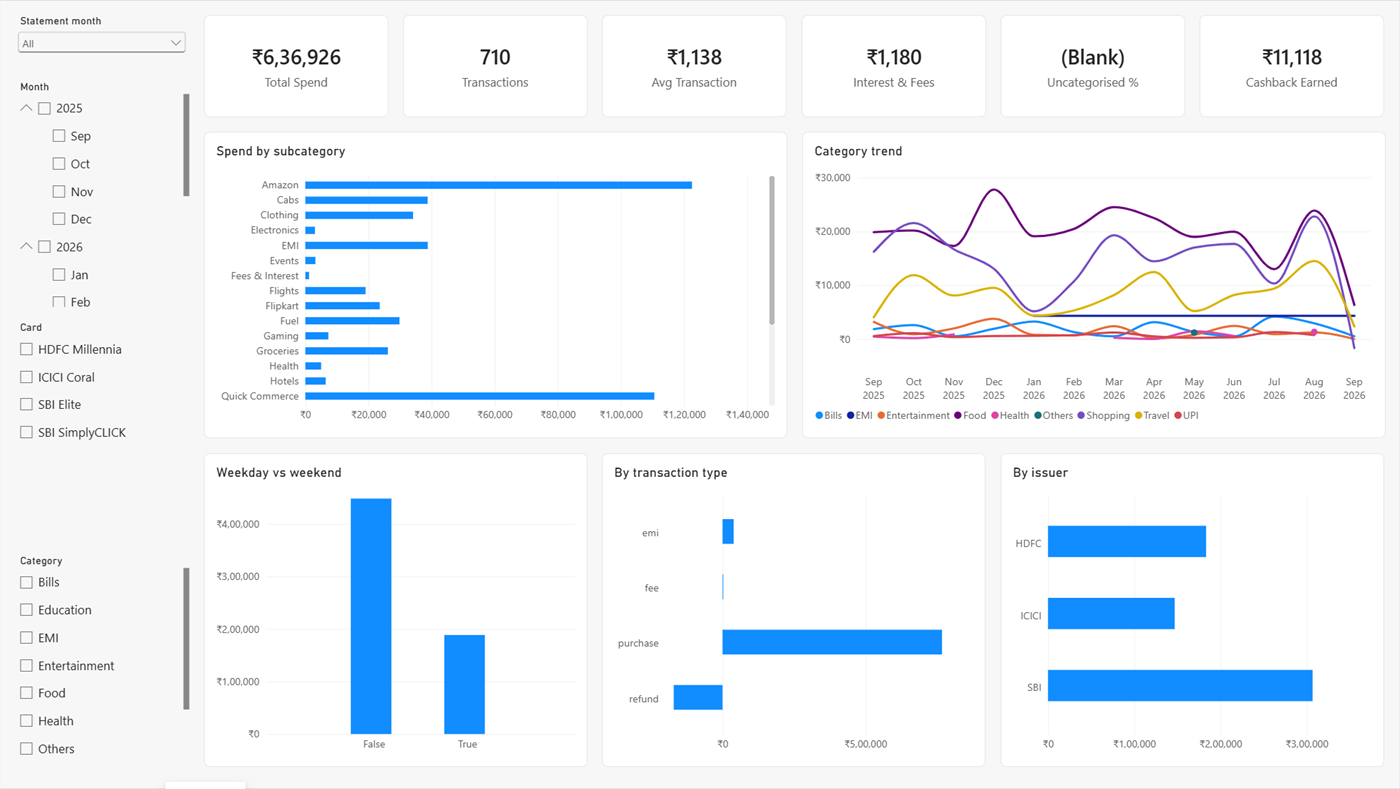
Power BI spending analysis page: spend by subcategory, a category trend over twelve months, weekday against weekend, spend by transaction type and by issuer, with interest, fees and cashback totals.
Spending analysis — subcategories, category trend, fees and cashback
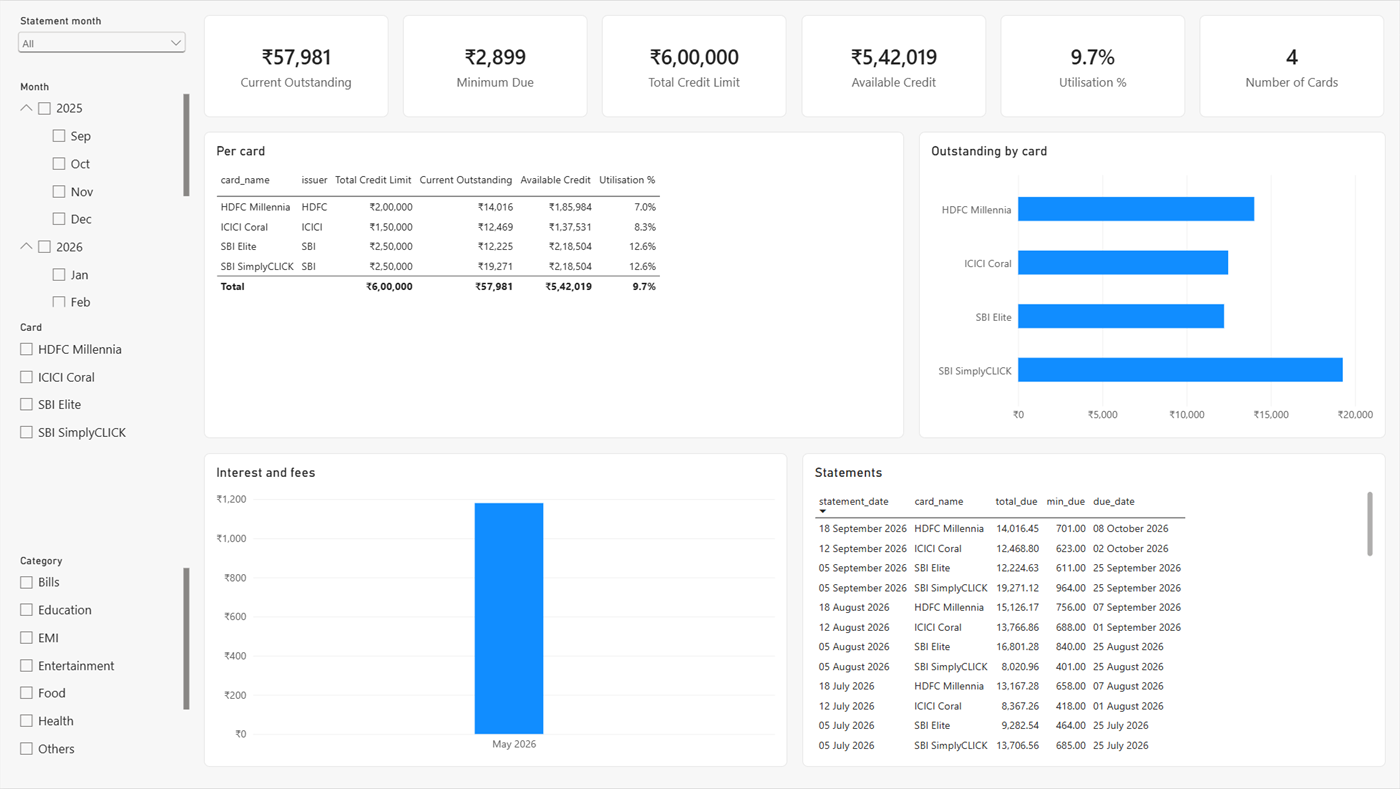
Power BI cards and bills page: outstanding balance, minimum due, credit limit, available credit and utilisation for each card, plus a table of statements with their due dates.
Cards and bills — limits and dues per card; a limit two cards share is counted once
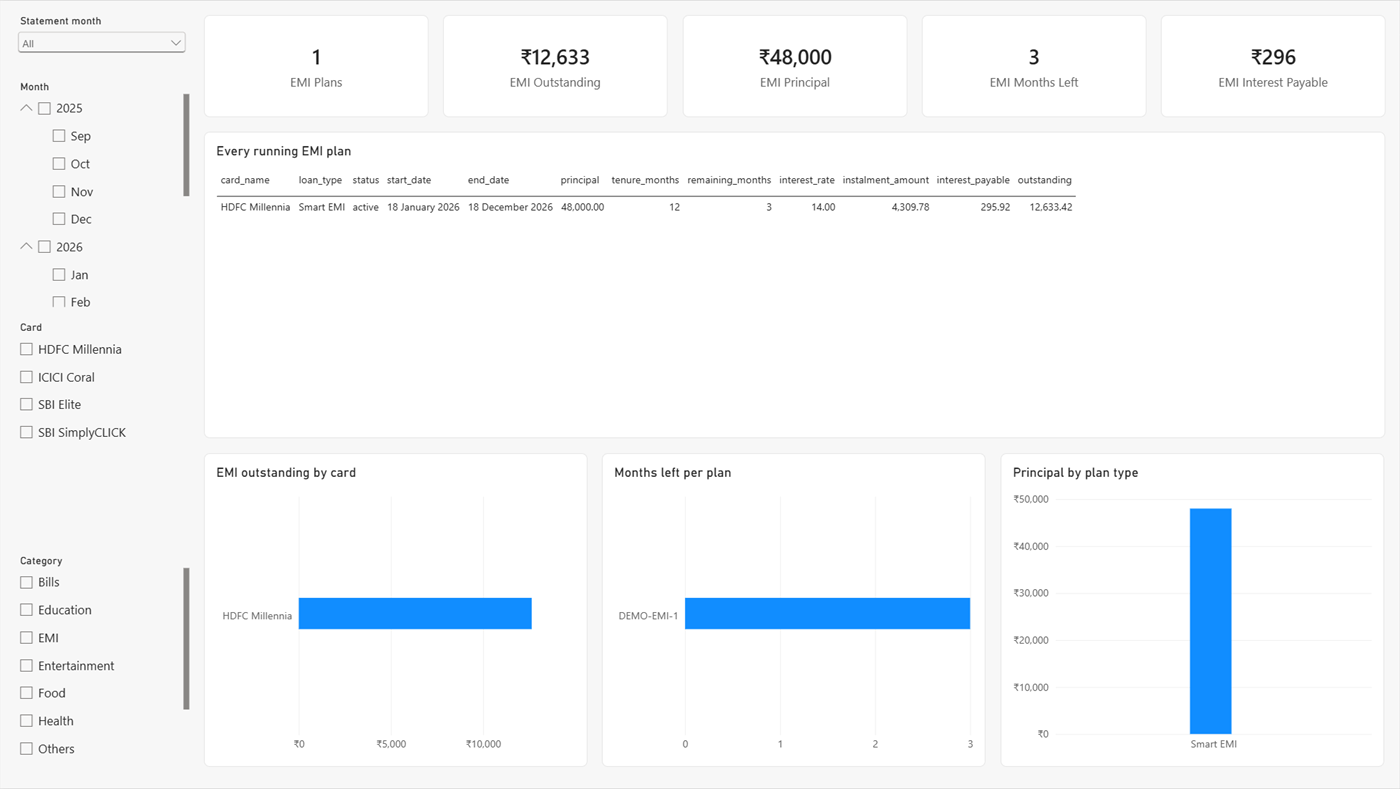
Power BI EMI page: every running EMI plan with principal, months left, instalment amount, interest payable and outstanding balance.
EMI — running plans, with principal against interest still to pay
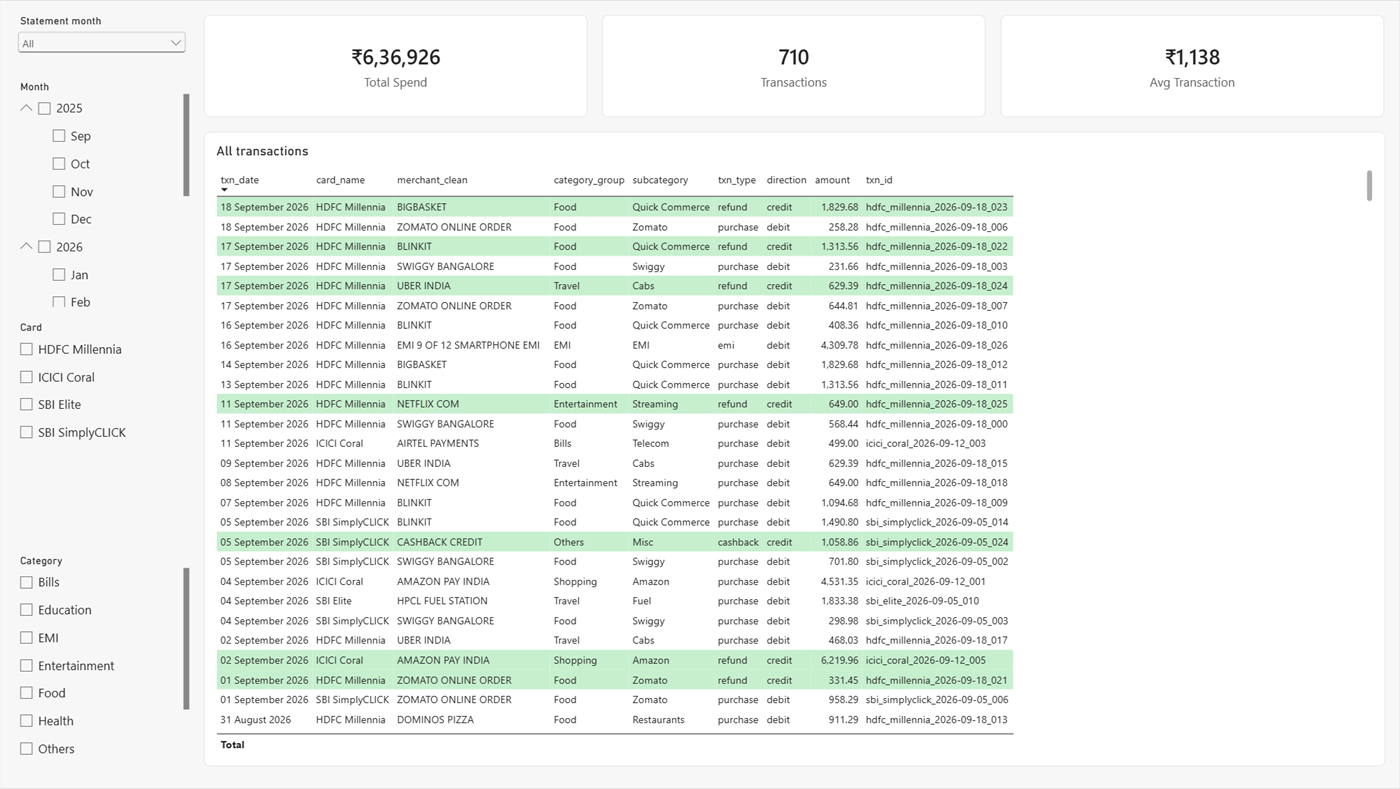
Power BI transactions page: every transaction with card, merchant, category, type and amount, with refund and credit rows highlighted.
Transactions — the full ledger, with refunds and credits highlighted

Every screenshot uses the repository’s made-up demo data, so the figures on them are not the real ones quoted above.

  • Python 3.11
  • pandas
  • pypdf
  • pdfplumber
  • Power BI
  • DAX
  • TMDL/PBIR
  • PowerShell
  • Windows Task Scheduler
  • UI Automation
  • IMAP/SMTP
  • keyring
  • pytest
  • ruff
  • mypy
  • GitHub Actions
Read the code on GitHub

Runs with no statements, on the demo data: cards demo, then cards dashboard --demo

History

Experience

PepsiCo GBS India LLP

Aug 2023 — Present · Kolkata, India

Process Analytics and Automation Associate Analyst (RPA / Automation Engineer)

One role, three years, four things that are mine to own. The job title says analyst; the work is platform ownership — the estate, the pipeline that ships to it, and the operations that keep it alive.

Delivery

Built the CI/CD pipeline six global teams now deploy through and moved automation codebases from Orchestrator into Git. 450+ automations have shipped through it, with deployment time per automation down from 30 minutes to 5.

Read the case study
Migration

Owned cloud migration for an entire sector — 200+ automations off the legacy UiPath framework onto a Windows-compatible framework and Cloud Orchestrator, with zero disruption to business operations.

Read the case study
Build

Delivered the products behind the numbers: an R&D samples system spanning intake and cross-border movement, an onboarding scheduler handling 650+ milestone events a month, and a procurement dashboard consolidating 27+ recurring reports.

Read the case study
Sustain & governance

Owns monitoring, incident resolution and break-fix for live automation products on UiPath Insights. Decommissioned 130+ idle licences for $250K in annual savings, and standardised how the team documents and investigates — four ServiceNow Knowledge Base articles and the org-wide RCA template.

Read the case study

Education

Vellore Institute of Technology

Jun 2019 — May 2023 · Vellore, Tamil Nadu

B.Tech, Computer Science and Engineering

Awards & certifications

Recognition

Awards from three years at PepsiCo, each tied to a specific piece of work, plus the certifications behind the stack.

  1. PFNA CIO Award

    2H 2023

    For leading the FSO Scheduler automation.

    Be Consumer Centric
  2. Bold & Better Award

    2025

    For strategic and transformation impact.

    Two-time recipient
  3. Smile Award

    For infrastructure and server optimisation, and high-impact Knowledge Base authorship.

    Infrastructure optimisation

Certifications

  • Automation Developer Associate

    UiPath Certified Professional

  • Automation Business Analyst Associate

    UiPath Certified Professional

  • Power Platform Developer Associate

    PL-400

    Microsoft

  • Azure Fundamentals

    AZ-900

    Microsoft

Toolkit

Skills

Intelligent automation
UiPath StudioRE FrameworkOrchestratorAutomation HubUiPath Insights
Microsoft platform
Power AppsPower AutomateSharePointOutlook integrations
AI & OCR
Agentic AIDocument Understanding
Programming
PythonSQLException handling
Cloud & DevOps
Azure DevOpsGitCI/CDWindows Migration
Enterprise tools
ServiceNowIncident ManagementProduction SupportRCAKnowledge Base governance

Contact

Have an automation estate that needs to move, scale, or stay up?